Truck blind spots: the no-zones around a semi, diagrammed
BY JEFF BYRD· TRUCK DISPATCHER, 8 YEARS IN TRUCKING· FACTS CHECKED 2026-10-27· UPDATED October 2026· HOW WE CHECK
QUICK ANSWER
In 2023, 18% of two-vehicle fatal crashes between a large truck and another vehicle started with an impact on the truck's side.NHTSA, Large Trucks: 2023 Data, Table 4 (left side 11.0%, right side 7.0%)
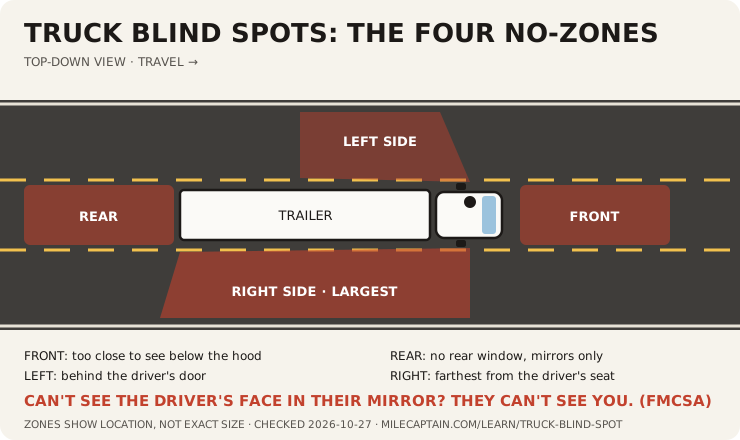
How many blind spots does a semi truck have?
Four. Truck drivers have large blind spots called No-Zones, and they sit in the same places on every tractor-trailer. Their exact size changes with the truck, the trailer, the mirrors and where the driver sits, which is why FMCSA describes where they are rather than how many feet they reach.
Front
Rear
Left side
Right side
Why the right side is worse: the driver sits on the left, so the right mirror is about the width of the cab away and seen at a sharper angle. The convex spot mirror helps, but it shrinks what it shows.
Not only semis: box trucks and hotshots
A 26 ft box truck has the same four zones in a shorter package. The box blocks the rearview mirror completely, so everything behind you comes from the side mirrors, and backing into a dock is where a spotter or a rear camera earns its keep. A hotshot pickup pulling a long gooseneck sits lower than a semi but the trailer is often wider than the truck, so standard pickup mirrors can't see past it; tow mirrors that extend beyond the trailer's width fix most of that.
SOURCE: FMCSA OUR ROADS, OUR SAFETY · CHECKED 2026-10-27
What the crash data shows about the sides of a truck
NHTSA's Fatality Analysis Reporting System records where a crash first made contact. For two-vehicle fatal crashes involving a large truck in 2023, the first impact on the truck was its front 60.8% of the time, its rear 21.2%, its left side 11.0% and its right side 7.0%. That data doesn't say a blind spot caused any of them, and we won't pretend it does. It does show that 18% of these fatal crashes started at the truck's sides, where the No-Zones are.
For scale: 5,472 people were killed in crashes involving large trucks in 2023, and 70% of them were in the other vehicle.
Mirrors: the rule and the setup
Federal rules require two outside rear-vision mirrors, one on each side, giving the driver a view of the road behind along both sides, meeting the federal mirror standard in force when the truck was built (49 CFR 393.80). Some fleets now run camera monitor systems in place of mirrors under FMCSA exemptions granted to specific makers; a regular truck still needs its mirrors.
- 1Seat firstSet your seat and posture before the mirrors, or every setting is off.
- 2Flat mirrorsA sliver of trailer on the inside edge, the rest showing the lane behind.
- 3Spot mirrorsAim the convex mirrors to cover the lane beside the cab and the front corners.
- 4Check itWalk a person or a car along each side and watch where they drop out.
That last step is a habit, not a rule, but it's the only way to learn where your own truck's No-Zones end. Redo the check after someone else drives the truck, after you move the seat, and any time a mirror takes a hit at a fuel island or a tight dock.
49 CFR 393.80 · CAMERA MONITOR EXEMPTION EXAMPLE (2025) · CHECKED 2026-10-27
Blind spots on a real shift
FMCSA tells truck drivers to check mirrors every 8 to 10 seconds and to scan about 15 seconds ahead, which is about a quarter mile on the interstate. In practice the risky moments repeat every day: merging off a ramp, changing lanes in heavy traffic, and right turns in town, where you swing left first to clear the corner and a car slips into the gap on your right. Before a lane change, signal early, check flat and spot mirrors twice, and move slowly enough that anyone hidden has time to react. Backing is the other daily one: if you can't see the whole path behind the trailer, get out and look before you move, and again if anything changes.
On a right turn, the space between the trailer and the curb is the most dangerous No-Zone in town. Check the right spot mirror as the trailer tracks in, and stop if anything enters it.
Rushed drivers check mirrors less. Some of that pressure comes from the plan: a downtown delivery set at rush hour, or a pickup that leaves no slack. When we dispatch, we look at appointment times and routes before the load reaches you, and if a slot means fighting peak city traffic, we ask the broker for a better one where it's possible. You still see the rate confirmation and decide.
FMCSA tips for truck drivers · checked 2026-10-27
Side and dash cameras for trucks · Safe driving tips for truck drivers
- Road-facing
- Driver-facing
- Side
- Rear
Fewer rushed miles, more planned ones
We dispatch owner-operators and small fleets on loads booked around your hours and lanes. Every load comes to you as a rate confirmation you can accept or turn down.
Sharing the road: what car drivers should know
If you drive a car, here's FMCSA's advice in short. Truck drivers probably can't see your vehicle if you can't see their face in the truck's mirror.
Don't linger
Merge with room
Give turns space
Stay back
Truck blind spots: common questions
General safety information. Not affiliated with FMCSA or NHTSA. Data is updated yearly when NHTSA publishes a new year.